

Media release
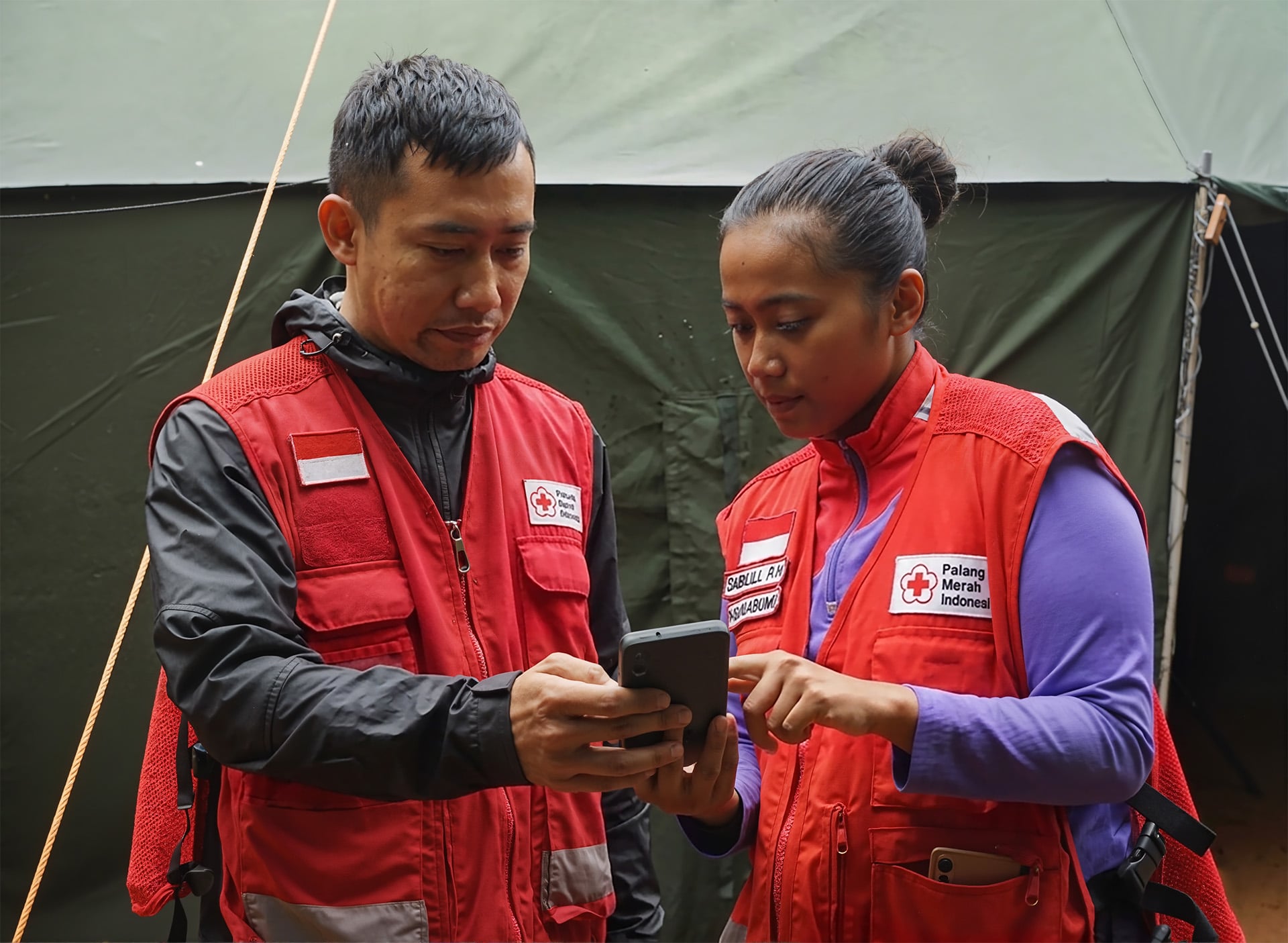
Two innovators have been named as the 2026 winners of the QBE AcceliCITY Humanitarian Challenge, expanding the impact of the global Challenge into Indonesia alongside Australia. This expansion advances a shared focus by Leading Cities, QBE and Australian Red Cross to scale practical, community‑led solutions that strengthen climate resilience.
Selected from a highly competitive global field, the two winning organisations – Bridgefy and Atma Connect – will each receive pilot funding of up to AUD $100,000 to test and refine their solutions in real-world humanitarian contexts. Bridgefy will deliver a pilot in partnership with Australian Red Cross, while Atma Connect will pilot alongside Palang Merah Indonesia, the Indonesian Red Cross Society.
The QBE AcceliCITY Humanitarian Challenge is a partnership between international civic innovation network Leading Cities, global insurer QBE, Australian Red Cross and the Global Disaster Preparedness Center. This Challenge provides a humanitarian focus within Leading Cities’ AcceliCITY program, providing direct support for early‑ to mid‑stage technology solutions to partner with communities affected by extreme weather, co-creating locally-led humanitarian initiatives that seek to strengthen climate resilience.
By embedding ethical practice and community voice from the outset, this Challenge helps innovators build trusted, adopted and ready to scale solutions that strengthen resilience to climate‑driven disasters.
In response to an increased volume of quality applications, the Humanitarian Challenge cohort was tripled this year, with 30 teams progressed through its rigorous 6-month selection and development process. Through Leading Cities’ AcceliCITY platform innovators completed the Humanitech Innovation Curriculum, received expert mentoring from and bootcamp sessions with frontline humanitarian practitioners, and worked directly with Australian Red Cross, the Global Disaster Preparedness Center and QBE teams across Asia Pacific to develop and pressure-test their pilot proposals.
The Australian pilot will be delivered by Bridgefy. Bridgefy enables offline communication during disasters through a mesh networking system that works without internet or mobile networks. Their solution includes a mobile app for communities and a dashboard for responders, allowing real-time coordination, emergency alerts and needs mapping even when infrastructure fails. Bridgefy helps close the communications gap in crises, ensuring people can stay connected and access help when it matters most.
The Indonesia pilot will be delivered by Atma Connect, a social technology organisation with deep roots in Indonesia. Its AI-enabled Resilient Community Coach (RCC) helps communities turn disaster plans and local knowledge into sustained readiness – enabling volunteers and local leaders to map risks, clarify roles, practise scenarios and coordinate action before and during emergencies. By connecting this often under-resourced community layer with formal disaster-management systems, RCC helps make neighbourhood preparedness more continuous, visible and scalable. It builds on Atma Connect’s AtmaGo platform, a trusted peer-to-peer information network that has reached more than 16 million people.
Lauren Hicks, Head of Social Impact at QBE, said the Challenge reflects a deliberate focus on long‑term resilience in the face of growing climate risk. “Extreme weather is reshaping communities across the Asia-Pacific region. Responding to this requires more than one‑off interventions. By supporting pilots that are grounded locally and designed to grow responsibly over time, and by working in partnership with organisations like Australian Red Cross and Palang Merah Indonesia, we seek to help create pathways for solutions that can adapt and deliver lasting value as conditions change.”
Blain Berhanu, Head of Innovation at Australian Red Cross, said: “For Red Cross, technology innovation is not about adopting new tools, but about improving outcomes for communities. When solutions are designed with communities and grounded in trust and local context, they are more likely to be used, adapted and sustained. This approach enables us to support stronger, locally led resilience that endures beyond pilots and programs.”
Michael Lake, President and CEO of Leading Cities, said the Challenge demonstrates how humanitarian innovation can move from promising pilots to practical adoption. “Locally shaped innovation is where resilience begins, but adoption is how it scales. Through our AcceliCITY innovation pathway and the QBE AcceliCITY Humanitarian Challenge, Leading Cities prepares innovators for the communities and public systems their solutions are meant to serve. We help turn pilot projects into proof points and pathways that can inform communities far beyond the pilot site, so what begins as local insight can become lasting resilience.”
For more information about the QBE AcceliCITY Humanitarian Challenge, visit:
https://www.humanitech.org.au/humanitarianchallenge/
Australian Red Cross is a volunteer-based organisation that exists to reduce human suffering. With 111 years’ experience and a community of 15,000+ members and volunteers, we act locally and connect globally to deliver what’s needed, when it’s needed most. We belong to the International Red Cross and Red Crescent Movement (the Movement) and, together with the International Committee of the Red Cross (ICRC), the International Federation of Red Cross and Red Crescent Societies (IFRC), and 190 other National Societies in countries around the world, we are part of the world’s largest humanitarian network; 16 million volunteers that help those impacted by disaster, conflict, health and other social issues.
Learn more: Australian Red Cross | Australian Red Cross
The QBE Foundation is committed to creating strong, resilient, and inclusive communities across its global operations. We work in partnership with community organisations, with a focus on both climate resilience and inclusion – two areas where we believe we can have the greatest impact. More information on the QBE Foundation can be found here.
Leading Cities is a non-profit organization with global reach that bridges the gap between innovation and implementation — helping municipalities and innovators overcome the procurement, regulatory, and scaling barriers that stall the adoption of proven solutions. Through AcceliCITY, AcceliGOV, Leading Cities Academy, and a network spanning more than 16,000 communities globally, Leading Cities sources and vets solutions, connects governments, innovators, industry, and capital to turn community resilience from ambition into action at scale. For more information, visit www.LeadingCities.org or connect on LinkedIn.
The QBE AcceliCITY Humanitarian Challenge is a unique cross-sector collaboration between Australian Red Cross, QBE Foundation and Leading Cities, focused on scaling community-led solutions for climate resilience since 2024.
The QBE AcceliCITY Humanitarian Challenge brings together capabilities rarely found in the same room:
Learn more: Humanitarian Challenge | Humanitech | Australian Red Cross